

When it comes to ocean creatures, the octopus is a true marvel. With its squishy body and mesmerizing movements, it’s hard not to be captivated by this eight-armed wonder. But wait—how many legs does an octopus really have? Is it eight, as most people think, or is there a hidden twist lurking beneath the waves?
Understanding Octopus Anatomy
An octopus possesses a unique anatomy that sets it apart from many other sea creatures. Its physical structure includes several distinct body parts, enabling it to thrive in various marine environments.
What Are the Main Body Parts?
An octopus consists of a bulbous head, also called a mantle, which houses its vital organs. It has eight extensible arms, lined with suckers that aid in movement and prey capture. The eyes show high visual acuity, capable of detecting color and shape. A beak, similar to a parrot’s, functions as a powerful tool for breaking into shells. The siphon serves multiple purposes, including jet propulsion for rapid movement.
How Many Arms vs. Legs?
Common belief identifies octopuses as having eight legs. However, these appendages are classified as arms due to their specialized functions. Each arm contains complex muscles and neural networks, granting the octopus remarkable dexterity and strength. Unlike traditional legs, octopus arms possess fine motor skills, assisting in intricate tasks like navigating tight spaces and manipulating objects. This distinction emphasizes their adaptability and evolutionary advantages.
The Classification of Octopus Limbs
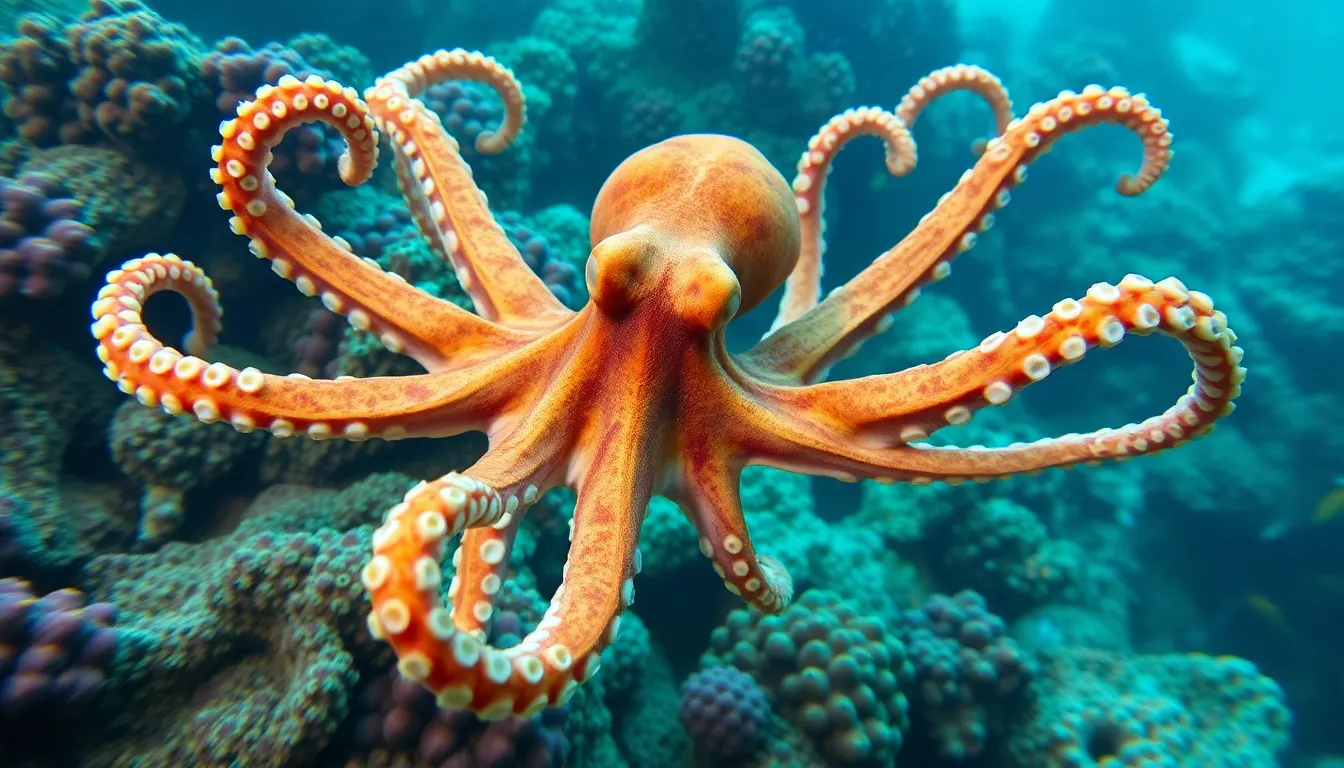
Octopuses possess unique appendages commonly referred to as arms. Understanding their classification helps clarify their functionality in marine life.
Differences Between Arms and Legs
Arms are distinct from legs in form and function. While octopuses have eight limbs, these are not legs but specialized arms. Each arm contains numerous suckers, which enable intricate manipulation of objects. Legs typically support locomotion, while octopus arms excel in dexterity and sensory perception. Structural composition further differentiates them; arms possess muscle and nerve cells allowing for complex movements. This fact emphasizes the unique evolutionary adaptation of octopus limbs to their environments.
Functional Roles of Each Limb
Each octopus arm serves multiple purposes beyond simple movement. Arms allow for grasping, feeling, and even tasting, all crucial for survival. Prey capture relies heavily on the strong suckers lining each limb. Arms also play significant roles in communication and camouflage, helping octopuses blend with surroundings. Balancing and navigating underwater environments depend on the precise coordination of these arms. This multifaceted functionality showcases the adaptability of octopus limbs in various marine scenarios.
The Biology Behind the Legs of an Octopus
Octopuses exhibit fascinating biological traits, particularly regarding their limbs. Understanding their unique anatomy reveals much about their adaptability.
The Unique Structure of Octopus Limbs
Each octopus arm contains numerous suckers, which enhance grasping and manipulation abilities. Suckers can detect textures and chemical cues, allowing for sensory perception. Structurally, arms consist of muscle fibers and nerve cells, enabling precise movements. The inherent flexibility of these arms allows for an array of tasks, such as opening jars and navigating rocky crevices. Designed for various functions, each limb serves as a multifunctional tool in the ocean. Notably, the evolutionary adaptations of these appendages contribute to the octopus’s survival.
Mobility and Movement Patterns
Movement patterns in octopuses demonstrate their versatility and speed. Arms operate independently, allowing for simultaneous actions. Octopuses utilize jet propulsion by expelling water through their siphon for quick escapes. Gliding through the water, they can also use their arms to crawl along surfaces. When hunting, graceful arm movements aid in stealth and agility. Coordination among arms enhances balance, making them effective predators in various environments. These diverse mobility methods showcase their adaptations, ensuring efficiency in their aquatic habitats.
Comparative Analysis with Other Cephalopods
Octopuses share interesting similarities and differences with other cephalopods. Understanding these relationships sheds light on their unique adaptations.
Octopus vs. Squid
Squid possess eight arms and two longer tentacles, distinguishing them from octopuses. This addition allows squid to reach prey from a distance. Octopuses, however, rely solely on their eight arms for manipulative tasks, showcasing their versatile behavior. Each arm on an octopus features a higher density of suckers, enhancing tactile sensation. Squid tend to be faster swimmers, thanks to their streamlined bodies. While squid employ jet propulsion effectively, octopuses often use it for stealth and escape. Communication methods differ greatly; squid utilize color changes for signaling while octopuses rely on texture and camouflage. These adaptations contribute to their respective survival strategies in diverse marine environments.
Octopus vs. Cuttlefish
Cuttlefish exhibit a unique blend of features that set them apart from octopuses. Though both possess eight arms, cuttlefish also have a distinct internal shell, aiding in buoyancy. Octopuses lack this structure, which impacts their movement style. Cuttlefish can change skin texture alongside color, allowing for extraordinary camouflage capabilities. Octopuses, on the other hand, mainly change color for blending into surroundings. Sensory input is a key factor; cuttlefish eyes are adapted for perceiving polarized light, granting them an edge in detection. Octopuses emphasize manipulation and tactile feedback through their arm suckers. These differences illustrate the diverse evolutionary paths taken by these remarkable cephalopods, enhancing their adaptability in various underwater niches.
The octopus stands out as a marvel of the ocean with its eight specialized arms that showcase incredible dexterity and adaptability. These arms are not merely limbs but multifunctional tools that allow for survival in diverse marine environments. Their unique structure and capabilities highlight the evolutionary advancements of octopuses, setting them apart from other cephalopods. Understanding the distinction between arms and legs deepens appreciation for these fascinating creatures and their remarkable adaptations. With each exploration of their biology and behavior, the octopus continues to captivate and inspire curiosity about the wonders of the underwater world.